
Portfolio
This page contains excerpts from my Professional portfolio. I have removed any media containing students and any reference to student names.
The portfolio was created in 2022 as part of the TRB’s pathway for experienced teachers.
Standard 1 Know students and how they learn
Standard 2 Know the content and how to teach it
Standard 3 Plan for and implement effective teaching and learning
Standard 4 Create and maintain supportive and safe learning environments
Standard 5 – Assess, provide feedback and report on student learning
Standard 6 – Engage in professional learning
Standard 7 – Engage professionally with parents, carers, colleagues and the community.
Standard 1 – Know students and how they learn
Play Based Learning
Educational theorists from the time of Jean Piaget and Leon Vygotsky have understood the critical role of play in children’s learning. Applied to music education the rich literature now available on play based learning provides access points for all students to enjoy the benefits of music education. There’s a reason we talk about “playing music” so in my classroom we learn through doing.
In my practice I focus on a continuum from Free Play to Work as described by Hansen, Bernstore and Stuber in “The Music and Literacy Connection”. I’ve taken advantage of this continuum of play as evidenced by my lesson plan and the video below.
Evidence of Student Impact
The following video, demonstrates student learning of the concept of space in music, and in this case, with the crucial skill of keeping time when playing in a group. Over a range of scaffolded activities that go from specific to open, based on the play based learning continuum, students can be seen to improve in both of these important skills.
Throughout the class the focus is on fun and moving the lesson forward, even at the expense of a little over-eagerness occasionally. This particular group has some very energetic characters. Occasionally I’ll make a deliberate choice to allow that to be expressed because I know that it won’t impede their learning or the learning of others, and the activities themselves sometimes encourage those behaviours. I know my students and I know how they learn. Annotations are embedded within the video.
Standard 2 – Know the content and how to teach it
Planning
The Australian Music Curriculum provides specific guidance, through the Achievement Standards, on learning outcomes at different Year Levels. When backwards planning I’ll start with these outcomes and explore ways in which they can be achieved in my classroom. In this way I find the Curriculum both specific and flexible enough to provide scope for my own contexts.
In the planning of the Rhythm Unit for my Grade 5/6 cohort I start with the Achievement Standards.
- Students use rhythm, pitch and form symbols and terminology to compose and perform music. They sing and play music in different styles, demonstrating aural, technical and expressive skills by singing and playing instruments with accurate pitch, rhythm and expression in performances for audiences.
- By the end of Year 6, students explain how the elements of music are used to communicate meaning in the music they listen to, compose and perform. They describe how their music making is influenced by music and performances from different cultures, times and places.
In a Rhythm Unit this means understanding how music is presented in time, developing the skills to be able to do that, and have the opportunity to present their skills and knowledge in a variety of ways.
A large part of the success of the music program at Austins Ferry Primary School has been the focus on Contemporary Music to engage students and maximise agency in listening, composing and performing activities. The Unit Plan does this by:
- Building practical skills as a means to develop understanding, learning by doing
- Presenting stylistic options relevant to their own musical preferences
- Achieving the learning outcomes prescribed in the Curriculum.
Evidence of Student Impact
This video demonstrates the use of Guided Play strategies to deliver explicit curriculum outcomes, in this case the second achievement Standard :”By the end of Year 6, students explain how the elements of music are used to communicate meaning in the music they listen to, compose and perform. They describe how their music making is influenced by music and performances from different cultures, times and places.”
According to Spiewak Tou et.al. (p 121) play does not always involve complete student agency: “Guided play maintains most traditional elements of play, especially the enjoyable and engaging nature and the child’s own agency, but adds a focus on the extrinsic goal of developing children’s skills and knowledge.” In this case the extrinsic goal is defined in the Unit Plan (lesson 3), as informed by the Curriculum, and delivered using proven Guided Play strategies.
In this case the first of the Achievement Standards is addressed through the Content Descriptors:
- Explore dynamics and expression, using aural skills to identify and perform rhythm and pitch patterns.
- Develop technical and expressive skills in singing and playing instruments with understanding of rhythm, pitch and form in a range of pieces, including in music from the community.
A standard rock drumbeat is presented that can be used in a variety of contexts, at different tempos and with different levels of dynamics and expression. They practice the drumbeat on practice pads and also at practice drumkits. The use of background music both scaffolds their learning and engages them in their activity allowing for one to one instruction when required.
Assessment
The assessment piece for this unit addresses the first Achievement Standard: “By the end of Year 6, students explain how the elements of music are used to communicate meaning in the music they listen to, compose and perform. They describe how their music making is influenced by music and performances from different cultures, times and places.”
Students composed a 3 or 4 part rhythm using a drum sequencer, using all of the principles they’d learned throughout the Unit, and then notated those parts using Standard notation. The use of technology allowed students to explore and ‘play’ with ideas free of any barriers imposed by instrumental technique. The following photos demonstrate understanding of this element of the Unit.

Standard 3 Plan for and implement effective teaching and learning
Planning
Performance opportunities are an important part of any music program. Early in Term 4 in 2021 we were offered an opportunity to present a musical piece at MONA as part of their 24 Carrot Garden Spring Festival. Over only a few weeks the school’s Rock Band used the skills that they’d been developing all year to put together a performance for the event.
To make the most of the opportunity the band was augmented by other students from Grades 5 and 6 on djembes and boomwhackers. This required a deal of planning including:
- Constructing appropriate parts for each student to play, according to both ability and the requirements of the piece.
- Ensuring copyright liabilities were met.
- Rehearsing the different sections, individually and together.
- Liaising with MONA staff around technical and organisational aspects of the performance (such as the Stage Plan below), and with colleagues at AFPS and at Claremont College to organise rehearsals, buses, RMP’s, loan and transport of instruments etc.
Customised Teaching Resources
There are very few resources available for primary school Rock Band programs. All of the performances our school band has had over the last three years have started with a customised arrangement specifically targeted to the learning goals of individual players. This one did as well but on a much larger scale. The original piece, Give Signs, was composed by Xavier Rudd, an Australian artist with indigenous heritage. My arrangement adapted the original for the school band and was further differentiated for students of varying abilities and with only a few weeks to prepare.
Implementation
To ensure technical requirements of the performance were met I also had to liase with MONA staff to ensure that all of the technical requirements of the event were met. The Stage Plan below was sent to MONA a week before the event and when we got there everything was ready to go.
Evidence of Student Impact
As evidenced by the video below this performance presented a particularly rich learning opportunity for all of the students (and teachers) involved. Thirty six students across Grades 5 and 6 had the opportunity to perform on the main stage at MONA in front of around a thousand people. It’s unlikely that most of them will have this type of opportunity again. Students also did the camera work for the video.
Standard 4 Create and maintain supportive and safe learning environments
Engaging learning activities supported by consistent routines and expectations create a safe and supportive learning environment in my classroom. I chose to make this standard the focus of my classroom observation and have included the observation report as evidence.
Standard 5 – Assess, provide feedback and report on student learning
Midline Crossing Assessment
This year in my role as a support teacher I needed to determine which students would benefit most from learning to play instruments that required crossing the midline. We know that there are links between cross-lateralisation and ADHD. We also know that trauma in children will affect brain development and that rhythmic regulation can help trauma-affected young people. I also know that playing the drumkit, an activity that could help with both midline crossing and rhythmic regulation, is a big drawcard for my students.
So I conducted a series of assessments at the start of the year that included a number of different drumming techniques that crossed the midline. Students were taught a simple rhythm that they could play without midline crossing before asked to do the same simple pattern, on different percussion instruments that required crossing the midline. The results were recorded and summarised in this document.
Evidence of Student Impact
The project then was to develop instrumental skills, learn a song and perform it to an audience. Those students who were identified as struggling with midline crossing were given tasks that promoted that activity. Other students chose their own instruments but still developed all of the social and collaborative skills that go with playing music together in small ensembles.
The student in the video was identified in the initial assessment as having difficulty with all of the midline crossing activities. In subsequent weeks as we worked on improving skills with bucket drumming she would refuse, act out and eventually drop out of the program.
When the opportunity arose later on to try again she grabbed it and can be seen here constructing her own patterns that, given the layout of the drumkit, naturally required her to cross the midline.
In the video she can be seen avoiding midline crossing by moving her body to face the drums. With small changes, such as sitting down or facing the camera she is forced to abandon these coping strategies and focus harder or change her playing in some way.
Given the clarity of the data collected it was very simple for me to report my findings to senior staff and to my colleagues. I had an opportunity to present the data to all teaching staff and spoke about the relevance of midline crossing to reading and hand writing, liased with Health and PE staff to monitor similar activities in selected students, and reported to classroom teachers around the impact of midline crossing activities on particular students.
Standard 6 – Engage in professional learning
In 2019 I attended a two day PL with the Australian Childhood Foundation entitled “Understanding the Neurobiology of Complex Trauma”. Then in 2021, the four day Berry St PL program on trauma informed practice. Both of these opportunities have allowed me to develop skills in the music classroom but also in my role as a support teacher.
In 2020, as part of my professional learning requirement, I chose to include a subscription to Bigger Better Brains, a resource providing access to best practice research for music teachers. I used this resource to explore options for the support programs that I was developing in 2021. Two peer reviewed papers on Music Therapy to develop Social Reciprocity and the application of the African philosophy of UBUNTI in social work informed my planning for both drumming circle sessions and a project to produce an album using hip hop styles and techniques.
Evidence of Student Impact
The following video, produced by the students as part of the hip hop album project, shows them collaborating with each other in meaningful and authentic ways to produce something with which they each have agency. The catch phrase in all of these projects is that we have a common goal, and each of us a role to play in making it happen.
Standard 7 – Engage professionally with parents, carers, colleagues and the community.
Christmas Carols Event 2021
At the end of 2021 our school put on a Christmas Carols event, a major undertaking for the whole school but the focus inevitably would be on the music program. Given COVID restrictions over recent years it was also a long overdue chance to engage with the community. My role was to teach the students a Christmas song that they could perform at the event, accompany them on a variety of instruments, and deal with the technical requirements for each performance. I also organised the staff band which was a big hit with students and colleagues.
To make that happen I had to:
- Liaise with colleagues to choose a song for their class, provide resources for them to practice and organise final group rehearsals.
- Contact parents and carers to ensure that students involved in the student Rock band could participate.
- Coordinate the technical and musical elements of the event to ensure its success for the whole community.
- Create arrangements and conduct rehearsals for the staff band.
Engage with colleagues
I created a list of songs that would be appropriate for each grade group and then asked colleagues for their recommendations.
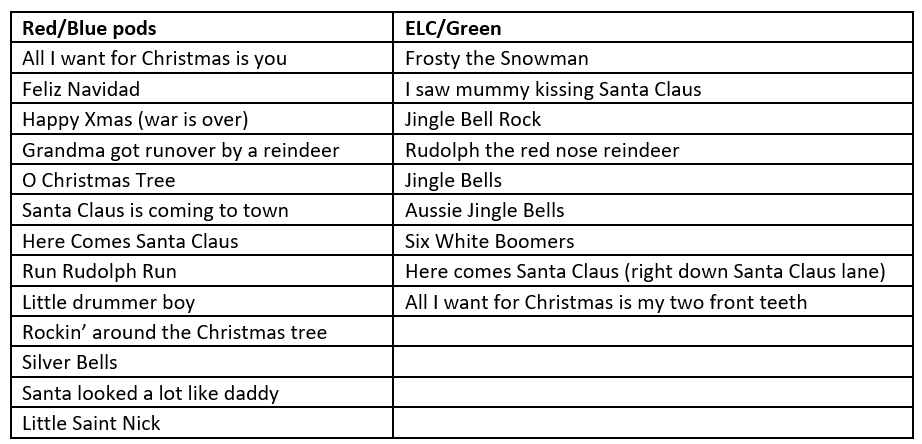
The following audio files are examples of those I made and shared with colleagues to help with their rehearsals.
Lyric sheets to share across classrooms to maintain consistency: Santa Claus is Coming To Town and The Little Drummer Boy
The vocal arrangements fot The Little Drummer Boy and All I Want for Christmas is You
I got a lot of support from my colleagues to make the musical elements of the event successful which speaks to their professionalism but I’d also hope that I made it as easy as I could for them to help me out.
Evidence of Student Impact
Student and community engagement in the event is evidenced by the following photographs and a letter from my principal attesting to its success.
 PatCurley.com